
What Economics Left Behind

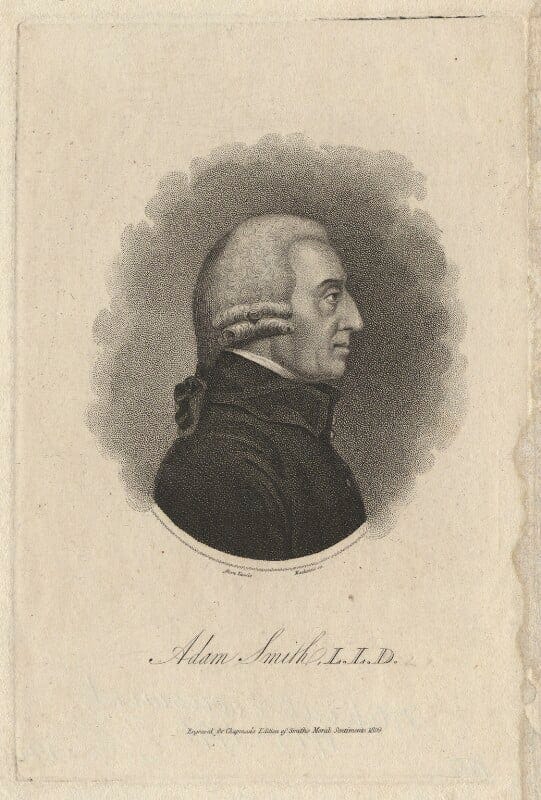
Source: Adam Smith by Mackenzie, after James Tassie stipple engraving, published 1809. National Portrait Gallery, London. Attribution-NonCommercial-NoDerivatives 4.0 International https://creativecommons.org/licenses/by-nc-nd/4.0/deed.en
Buying heroin is easier than hiring a hitman. Both are illegal. But ask around an unfamiliar town for one, and you will eventually get a phone number. Ask for the other, and you will probably end up talking to a police officer.
This is the kind of puzzle Alvin Roth chases in his new book, Moral Economics (Hachette, 2026), reviewed recently in The Economist. Roth won a Nobel Prize for market design—for figuring out how to pair people when prices cannot do the work, as with kidney donors and recipients. That work led him to what he calls repugnant transactions: exchanges where a willing buyer and a willing seller would happily trade, but someone not party to the deal wants to stop them. Heroin, hitmen, organs, sex, surrogacy, paying people to catch a disease so a vaccine can be tested. The boundaries are real, consequential, and gloriously inconsistent. Horsemeat is dinner in Quebec and contraband in California. Surrogacy is banned across much of Europe and sold across much of America, where the rules on sex work run the other way.
Roth treats these inconsistencies as a research opportunity, and he is right to. They are natural experiments in what happens when you ban a thing versus permit it. His rule of thumb is sensible: weigh the harms of allowing an activity against the harms of disallowing it. Economics 101.
The reviewer admires the book and then lands a blow. Roth, the argument goes, keeps retreating to the position that there is no point arguing about moral principles because no one will agree. That makes morality exogenous—a fact generated outside the economic model, when it shouldn’t be. This is the right criticism. It is also older and deeper than the reviewer lets on. Roth’s exogenous morality is not a quirk of one book. It is the field’s founding error, repeated.
There is one Smith, and economics simply kept half of him.
Economists like to trace themselves to Adam Smith and The Wealth of Nations. They forget that the same man wrote The Theory of Moral Sentiments first, and revised it until the year he died. There are not two Smiths in tension, the cynic of the market and the moralist of sympathy. There is one Smith, and economics simply kept half of him.
It took the invisible hand and left behind the impartial spectator, the faculty of sympathy, the mutual regard that Smith made the ground of the whole system. The market mechanism was never meant to stand on its own. It was the upper story of a building whose foundation was moral psychology. Strip the foundation, call what remains a complete science, and you get exactly Roth’s move three centuries later: morality treated as something outside the model, a constraint to manage rather than the foundation on which the model was always resting.
So the reviewer is right that morality should be argued, not bracketed. But the reviewer drops the ball. His closing move ignores Smith. And once Smith is back in the picture, the whole frame changes.
Markets sit on a substrate
Markets do not float free. They run on top of institutions—the rules that decide who can own what, who can sell what, who is protected, and who is exposed. Daron Acemoglu and James Robinson have spent two decades showing that the character of those institutions is the single biggest thing separating rich societies from poor ones. Their distinction is between inclusive institutions, which spread economic and political power broadly, and extractive ones, which concentrate it in a few hands. Inclusive arrangements tend to reinforce themselves, because widely held power resists encroachment. Extractive ones reinforce themselves too, for the opposite reason.
But institutions are not the bottom layer. They are written down, encoded, enforced—and that raises the question of where the tendency to design and sustain inclusive ones comes from in the first place. This is the gap Smith fills, and Acemoglu and Robinson leave open. Inclusive institutions are the formal expression of mutual regard: of a willingness to take Smith’s impartial spectator’s view, to grant that the other party’s stake is as real as your own. The sentiments come first. The institutions encode them. The markets run on top. Smith’s moral psychology is the substrate beneath the institutional substrate.
Set Roth’s repugnant transactions on that foundation, and they stop looking arbitrary. The question is not really “do the harms of allowing this outweigh the harms of banning it?” measured as a lump of aggregate welfare. The question is about power. Who ends up selling a kidney, and from what starting position? Who is protected from having their body priced into a market they entered out of desperation rather than choice? A society that refuses to let market logic colonize organs or bodies is not being squeamish. It is drawing the line that keeps an exchange from becoming extractive. The substrate is doing the moral work, and the cost-benefit ledger cannot see it.
This is why treating morality as exogenous fails. The “moral constraint” Roth wants to route around is not a fixed feature of the landscape. It is the substrate the market was always standing on—the sentiments and the institutions that encode them—and that substrate is made. Designed, contested, revised, sometimes neglected until it erodes. It is the most endogenous thing there is.
The substrate grows from the bottom up
Here is where Acemoglu and Robinson stop and where our work begins.
Acemoglu and Robinson’s Why Nations Fail operates at the scale of nations and centuries. Its mood is close to fatalistic: institutions shift only at rare critical junctures, through contingency and narrow windows, and extractive equilibria are brutally hard to escape. If that were the whole story, the substrate would be something that happens to a region, not something a region can shape.
That is the whole story. The national institutions may be stuck, but the substrate has a meso scale—the region, the ecosystem, the network—and at that scale it can be deliberately designed and cultivated. Inside a nationally extractive arrangement, a region can still widen who participates, distribute the power to define problems, and rebuild the mutual regard that inclusive institutions are made of. The substrate is not only inherited. Some of it is grown.
Cleveland in the late 1970s is a case in point. The city had gone bankrupt. Its civic institutions had turned extractive — politicians engaged in small and large theft, corporations leveraging their power against the public interest. At the national scale, nothing was coming to save it. But at the regional scale, something shifted. When the major anchors — the Cleveland Clinic, the law firms, the remaining corporate headquarters — looked around and realized that no one outside Cuyahoga County cared whether Cleveland survived, they put their swords down. Not out of virtue. Out of necessity.
They began, slowly and deliberately, to rebuild the civic ecosystem from within: widening the table, redistributing the work of defining problems, rebuilding the mutual regard that had collapsed. My brother, Hunter Morrison, Cleveland's planning director through those decades, spent hours talking about the lessons of Cleveland and the connection to Strategic Doing. He described Cleveland’s hinge moment plainly: when civic institutions become extractive, you are on the road to collapse; when they become inclusive, you are on the road to prosperity. Cleveland chose the second road — not because the national context permitted it, but because a region of willing pragmatists decided to grow something new from what they still had.
This is what Strategic Doing actually is, stated plainly: a practice for regenerating Smith’s moral sentiment at the scale where ecosystems form. Its rules read, in this light, as a protocol for Smith’s impartial spectator. Establishing equity of voice so the quiet participant’s stake is treated as real as anyone else’s. Cognitive diversity means that the power to define the problem does not concentrate in one view. Structured collaboration so a wider set of people genuinely sets the ends in view rather than ratifying someone else’s. Transparency practiced, not mouthed. These are not procedural niceties. They are how mutual regard gets manufactured among people who started as strangers, and mutual regard is the foundation Smith laid, and economics forgot.
Roth is right that you cannot expect consensus on first principles. But the response is not to declare the principles off-limits and retreat to a spreadsheet and the economist’s welfare ledger. The response is to regrow the substrate that lets people work out their differences without one party extracting from another. That substrate is the precondition for markets worth having. Smith knew it was there. Economics forgot.
None of this arrives from the top—it is designed, cultivated, and stewarded from the bottom, in regions, one collaboration at a time.
This post is part of a series exploring what Adam Smith actually argued — and what we lost when economics forgot The Theory of Moral Sentiments. Smith understood that markets are embedded in civic life, that exchange depends on mutual regard, and that prosperity is a social achievement before it is an economic one. The substrate argument in this post is, at bottom, Smith’s. I discovered the connection in the 1990s as I was first developing Strategic Doing, an open standard discipline for deliberately designing and cultivating that substrate — at the scale where it can actually be grown. More at the Strategic Doing Institute.
Posts in the series: