
The Future Isn’t Evidence. Until You Act On It.

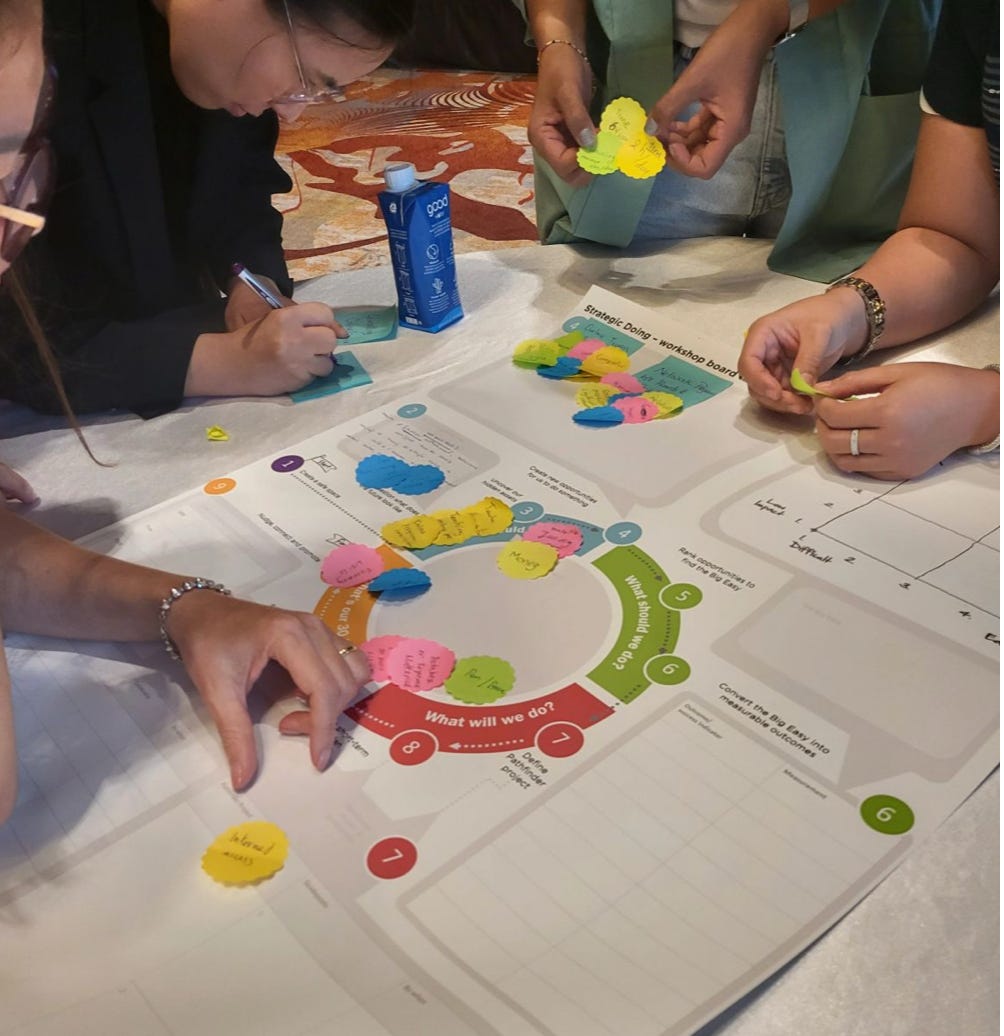
Governments, foundations, and corporations now spend serious money on strategic foresight. Scenario reports. Horizon scans. Megatrend analyses. The outputs are often impressive — well-researched, carefully produced, intellectually serious.
And then…nothing changes.
A new paper in Policy and Society by Laura De Vito and Gaia Taffoni names this honestly. Strategic foresight faces a persistent translation problem: the gap between generating future-oriented evidence and actually doing something with it. That gap is the subject of this post. And it’s exactly the gap Strategic Doing is designed to close.
What strategic foresight gets right
We need future-oriented evidence. Past data isn’t enough when you’re navigating climate transitions, demographic shifts, or technological disruption. The conditions that shaped yesterday’s decisions aren’t the conditions you’ll be operating in tomorrow.
Foresight tools do something valuable. Scenarios, horizon scans, trend analyses — they expand the range of futures that people can imagine and talk about. They surface risks that conventional planning ignores. They invite the kind of long-horizon thinking that day-to-day pressures crowd out.
De Vito and Taffoni look at two serious examples: the UK Government Office for Science’s Net Zero Society: Scenarios and Pathways report, and the EU’s ESPAS Horizon Scanning initiative. Neither is a failure. Both are thoughtful, resource-intensive efforts to bring future-oriented thinking into policy. The problem isn’t the quality of the work.
The problem is what happens next.
Three problems foresight can’t solve for itself
De Vito and Taffoni identify four recurring challenges in using evidence for policymaking. Three of them hit foresight especially hard.
The first is a standards problem. No one fully agrees on what counts as good foresight. Quantitative methods earn more credibility, even when the question is inherently qualitative. Foresight outputs are seen as value-laden — which they are — and that perception is used against them. Compared to a randomized controlled trial, a scenario narrative looks soft. The hierarchy of evidence is real, and foresight sits low on it.
The second is a translation problem. Scenarios don’t automatically become decisions. The gap between “here are four plausible futures” and “here is what we do next Tuesday” is enormous, and most foresight exercises don’t bridge it. The UK Net Zero report is explicit that it’s exploratory and non-prescriptive. That’s intellectually honest. It’s also, in practice, a door that doesn’t fully open.
The third is a participation problem. Foresight works best when it’s inclusive and iterative. In practice, it’s usually expert-driven, technically demanding, and produced at a distance from the people who will actually have to act. Both cases in the paper show the same pattern: public engagement happens late, after the scenarios are already shaped, and its influence on the final product is hard to trace.
The paper’s conclusion is fair: foresight should be treated as a complementary form of evidence, not a standalone one. It needs to be embedded in a broader ecosystem of knowledge and practice.
Fine. But what does that ecosystem look like?
The missing piece
De Vito and Taffoni don’t name Strategic Doing. But they describe exactly what it does.
They argue that foresight becomes usable evidence when three conditions are met.
First, it needs to be robust — produced through transparent methods, tested against multiple possible futures, and open to scrutiny.
Second, it needs to be appropriate — tailored to the specific context and decision cycle, with clear guidance on how to use the outputs.
Third, it needs to be inclusive — drawing in diverse voices, early in the process, with genuine influence on what gets explored.
Strategic Doing addresses all three. Not by producing better reports. By changing the nature of the conversation.
What Strategic Doing does differently
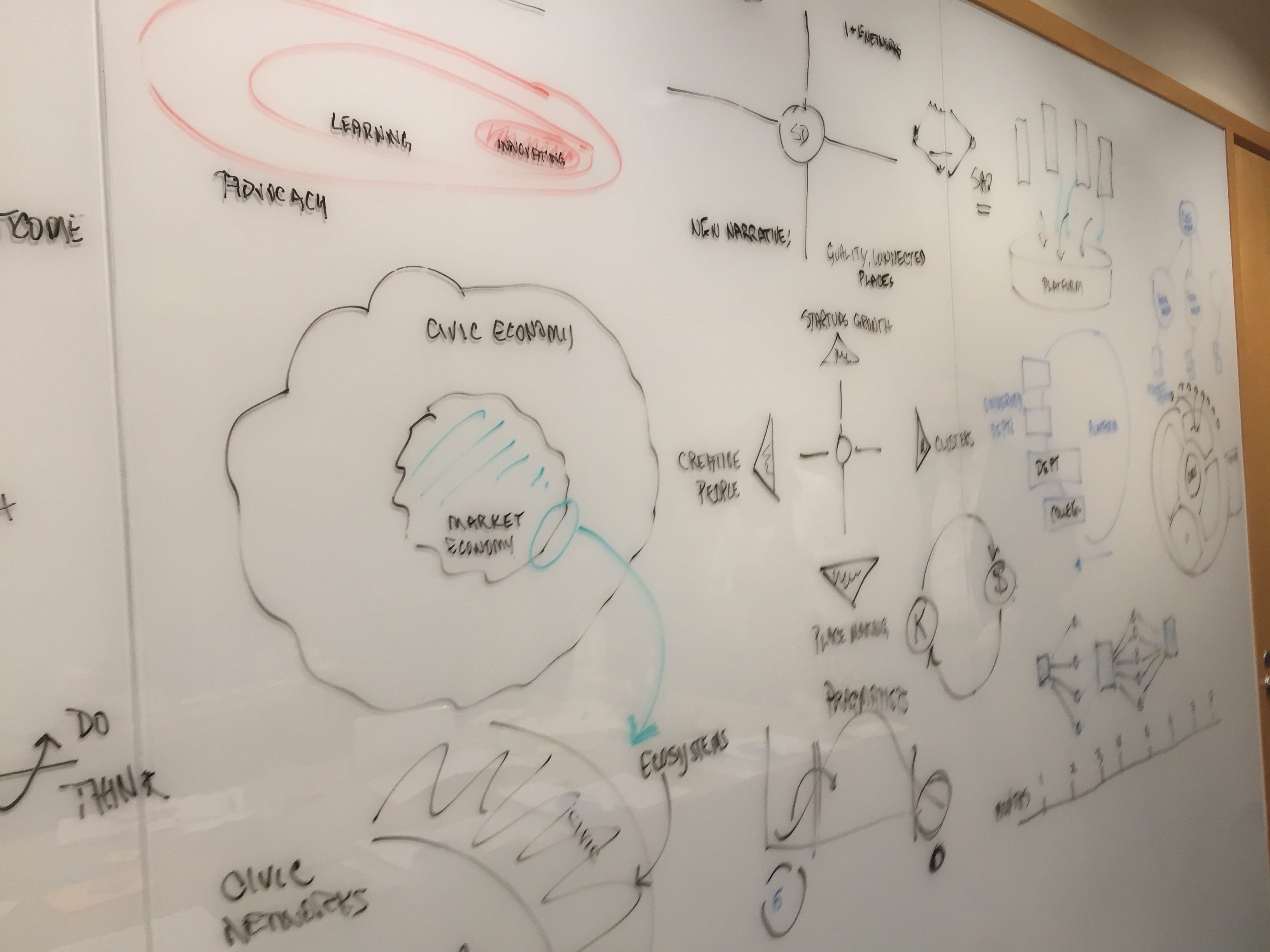
The first difference is where the inquiry starts. Strategic foresight asks: what might the future look like? That’s a good question. But it doesn’t, by itself, move anyone. Strategic Doing asks a different question: what could we do together, right now, with what we have? That question is grounded. It’s actionable. And it’s where foresight outputs can actually land — as inputs to the conversation, not as answers to it.
A scenario describing four possible energy futures in 2050 becomes far more useful when a room full of people can ask: given these possibilities, what assets do we already have? What experiments could we run in the next thirty days that would teach us something? What’s the smallest move that tests our most important assumption?
The second difference is how Strategic Doing treats outcomes. John Dewey called provisional aims “ends-in-view” — hypotheses about what better looks like, subject to revision as you learn. Strategic Doing builds this into its structure. The 30/30 cycle — a short, repeated action-and-review loop — isn’t a reporting mechanism. It’s a learning mechanism. Each cycle tests assumptions and updates the picture. You don’t need certainty about the future to run one. You need a direction and a willingness to see what happens.
The third difference is how futures literacy actually develops. De Vito and Taffoni argue that building futures literacy is essential — the capacity not just to read foresight outputs but to critically co-create, interpret, and evaluate them. They’re right. But you don’t develop that capacity by reading scenario reports. You develop it by sitting in a room with people who see the world differently, trying to identify what you could build together, and then going out and trying. Strategic Doing is structured futures literacy practice. The skills are learned through doing, not through study.
The integration opportunity
Think of strategic foresight as producing raw material. Scenarios, signals, trend maps — these are inputs. Strategic Doing provides the process for turning that material into coordinated action.
Scenario outputs become inputs to a framing question. Horizon scan signals become prompts for identifying underused assets and adjacent possibilities. The logic of testing decisions across multiple possible futures maps naturally onto pathfinder projects — small bets designed to generate fast learning at low risk.
This isn’t a theoretical claim. It’s a design choice. Any team running a Strategic Doing session can incorporate foresight evidence as one deliberate layer of the conversation. Here’s what we know about where things might be heading. Here’s what we have. Here’s what we could try. Let’s find out.
The ESPAS exercise in Brussels is actually closer to this model than it looks. Monthly workshops, rotating participants, signals discussed and stress-tested in real time. What it lacks is the action discipline — the clear move from sense-making to coordinated doing. That’s the gap Strategic Doing fills.
A closing thought
The problem with strategic foresight isn’t the quality of the thinking. It’s the absence of a practice for acting on it.
Evidence without action is still just evidence. And in complex, fast-moving environments — where no single organization holds all the resources, authority, or expertise needed to solve the problem — evidence without a way to coordinate action across boundaries is evidence that goes nowhere.
Strategic Doing is the discipline that turns future-oriented inquiry into something people can actually do together. Not by simplifying the complexity. By giving it structure.
The future is imaginable. The question is whether we have the tools to act on what we imagine.
We do.
One more thing
If this challenge is live in your organization, I’d point you toward Julio José Prado. Julio is CEO of the Strategic Doing Institute, former Minister of Production and Trade in Ecuador, and professor of business at IDE Business School in Quito.
He has worked at the intersection of strategic foresight and Strategic Doing across national and regional contexts — including leading Ecuador’s national competitiveness strategy. He has developed Economic Foresight, his own approach for businesses and governments, based on his extensive experience in executive roles.
He’s the person to talk to if you want to move from foresight outputs to coordinated action.
To schedule a conversation with Julio, contact Jessica Olives at the Strategic Doing Institute: jessica@strategicdoing.net
References:
De Vito, L., & Taffoni, G. (2026). Evidence for the future? Strategic foresight as a source of evidence for policymaking. Policy and Society, puag009. DOI: https://doi.org/10.1093/polsoc/puag009
Morrison, E., Hutcheson, S., Nilsen, E., Fadden, J., & Franklin, N. (2019). Strategic doing: Ten skills for agile leadership. John Wiley & Sons. bit.ly/SDWiley Amazon (US) Amazon (UK) Amazon (AU)
Morrison, E. (2021). Strategic Doing: A Strategy Model for Open Networks (Doctoral dissertation, economics, University of the Sunshine Coast, Queensland). DOI: https://doi.org/10.25907/00087
Ed — past data fails under complexity. That’s exactly why MFiM-OS™ has a Scenarios & Foresight module built into the platform layer. Strategic Doing generates the evidence. MFiM-OS™ runs it.
Love this