
Drawing What We Cannot See
Part 1 of 2: Designing a Language for Collaboration

Source: Wikimedia
I did not fully understand what I was building with Strategic Doing until I walked into Bei’s lab at the Cleveland Clinic.
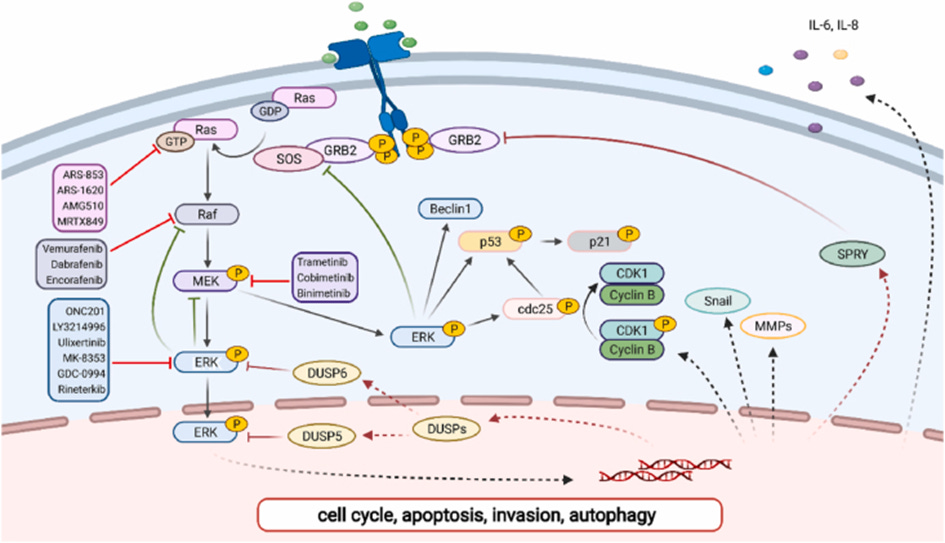
Bei is a molecular biologist and cancer researcher. On the wall behind her desk, she had pinned a dense, hand-annotated map. At first glance, it looked like a tangle of colored lines, boxes, and arrows — something between a subway map and a wiring diagram. To her, it was a signaling pathway for apoptosis, the process of natural cell death.
Apoptosis is one of the body’s quiet miracles. Cells are supposed to die when they are damaged or no longer needed. In healthy tissue, this programmed cell death protects the larger system. In many cancers, that process is switched off. Cells that should quietly remove themselves instead remain, divide, and spread. Bei’s map showed the molecular conversations that decide whether a cell lives or dies: signals being sent, received, amplified, blocked. Somewhere in that maze of interactions, the “time to die” message was being interrupted.
Standing there, listening to her describe where the pathway breaks down in certain tumors, I realized we were both working on the same kind of problem. We were both trying to understand complex networks we could not see. She studies cascades of molecular signals. I study cascades of human interaction — conversations, commitments, handoffs, trust. Neither of us ever sees the whole system directly. We see traces, patterns, and consequences. She sees uncontrolled growth in a tissue sample. I see stalled initiatives and frayed partnerships in a community or an organization.
Bei’s map is not a picture in the decorative sense. It is a working instrument. It tells her team where to look next, which interaction to probe, which molecule to target so that the natural “time to die” signal can get through again. It is a language of signs that stands in for an invisible reality and makes intelligent action possible.
Looking at that wall, I finally had words for what I had been doing for years. Strategic Doing is, at its core, a semiotic project: a disciplined effort to build a shared language that makes invisible networks visible enough to act on. What I had really been assembling, piece by piece, was not just a method or a process. It was a new language for collaboration — a set of verbal and visual signs that help ordinary people see the networks they are part of, long enough to ask better questions and run smarter experiments.
This post is about how that language was built, and why it had to be built from scratch.
The Networks We Cannot See
Bei’s map stayed with me because it put something in front of my eyes that normally lives out of sight. I have never seen apoptosis itself. I can see its consequences — in healthy tissue or in a tumor — but not the signaling process directly. Those signals have to be inferred, modeled, and drawn. Her diagram was a way of saying: here is the invisible conversation that determines whether a cell lives or dies.
Collaboration works in much the same way. We see the consequences — a new initiative launched, a region gaining momentum, a partnership beginning to generate results — but we rarely see the network of interactions that made those outcomes possible. We do not see the invitation that opened a door, the exchange of trust that lowered a barrier, the small commitment that made a larger one possible, or the quiet alignment of assets that gave a project life. These, too, are signaling pathways. They are the micro-interactions through which a human system decides whether something new can emerge.
To see why this matters, it helps to distinguish collaboration from two simpler forms of collective action. Cooperation is what happens when people pursue separate goals while avoiding conflict. They stay largely in their own lanes. Coordination goes further: people contribute resources to a known, shared goal. The outcome is already defined, and the challenge is to align tasks, timing, and roles efficiently.
Collaboration is more demanding. It operates under conditions of uncertainty. The goal is not fully known in advance. People explore how to link, leverage, and align their assets into new combinations that create value for each participant and for the group. Collaboration is a process of recombinant innovation. It is not simply execution. It is discovery.
That is why Dewey’s idea of “ends in view” matters here. In a true collaboration, people are not marching toward a fixed target with a settled blueprint. They are moving toward a shared but uncertain outcome — an end in view that is concrete enough to guide action but provisional enough to be revised through inquiry. The destination becomes clearer through the work itself.
This kind of collaboration shows up most visibly in what I have come to call the confluence zone — the place where the market economy and the civic economy overlap. It is where the next pathway to growth is not yet clear, where a single firm cannot capture enough of the value to justify going alone, and where public investment without private commitment goes nowhere. The evidence of genuine collaboration is not hard to read when it appears in this zone. Public and private partners commit real resources to shared initiatives. They allocate risk together rather than pushing it onto one side. They make investments that neither party would make unilaterally, because the opportunity only exists in the combination. That is the signature of genuine collaboration: not a memorandum of understanding, not a working group, not a shared hashtag. Real money, real risk, real skin in the game — pointed at something neither partner could reach alone.
But here is the structural problem. In a hierarchy, a leader can direct people toward that kind of commitment. In the confluence zone, no one has that authority. No one can tell anyone what to do. The network is voluntary all the way down. That changes everything about how strategy has to work. You cannot plan your way to collaboration in an open network. You cannot mandate it. You can only design conditions that make it more likely — and guide the conversations through which it actually emerges.
This is why Strategic Doing gradually became, for me, a way to draw the invisible. Rendering collaboration visible requires a different kind of language — one that existing planning tools were never designed to provide.
The Old Signs That Trapped Us
By the time I began shaping Strategic Doing, most organizations already had a well-developed visual and verbal language for strategy. That language mostly pointed in the wrong direction. It was underbrush I had to clear before anything new could grow.
The familiar signs are easy to list: three-ring binders full of plans, elaborate Gantt charts, SWOT matrices, vision statements word-smithed to exhaustion, laminated value posters on the wall. None of these are neutral. Each one quietly tells people what strategy is and how they are supposed to behave. A thick binder says strategy is something written by experts and placed on a shelf. A Gantt chart says the future is already mapped and everyone’s job is to stay on schedule. A vision statement on the wall says the work is to find the right inspiring sentence, not to run the next experiment.
These are semiotic devices. They invite certain moves and make others less thinkable. Once a SWOT slide appears on a screen, people know their lines. Someone lists “strengths,” someone lists “weaknesses,” and everyone waits for the leader to synthesize. The semiotics of the room are doing the work long before anyone reflects on whether the exercise will actually change behavior. These tools were optimized for a world of prediction, control, and fixed endpoints — a world where someone has authority and uses it. For collaboration in the confluence zone, they were worse than useless. They actively crowded out the fragile shoots of a different kind of practice.
Clearing this underbrush meant removing certain signs from the room entirely. No vision statement exercises. No thick templates. No roadmaps pretending to know the path in advance. It meant moving from rows of chairs to small tables, trading the slide deck for butcher paper and markers. Before I could introduce a new language for collaboration, I had to quiet the old one. Only then could people stop performing “strategy” as they had learned it and begin to notice the network they were actually in.
Designing a New Language
Once the old planning semiotics were pushed to the margins, a different question came into focus. If those familiar signs pulled groups back into prediction and performance, what kind of language would pull them into experimentation and collaboration instead?
The verbal side came first. Certain questions shifted the room in ways I could not ignore. “What are our goals?” pulled people back into abstraction and argument. “What could we do together in the next 30 days?” pulled them into concrete possibility. “What are our strengths?” invited a familiar SWOT monologue. “What assets do we have inside and around this room that we could link and leverage?” invited people to look at one another differently. Over time, these questions settled into a pattern: short, repeatable prompts that steered attention toward assets, connections, and near-term experiments rather than deficits, barriers, and distant ideals.
The visual language emerged more slowly, and it emerged in conversation.
In the 1990s, I began meeting every Saturday morning with my colleague Kim Mitchell, an architect by training. Architects are trained in the art of picturing a future and sharing it with clients. They translate vague desires and real constraints into sketches people can recognize themselves in. That made Kim an ideal partner in developing a visual language for Strategic Doing. We would sit in rocking chairs in his office, facing a whiteboard. I would describe what I had seen during the week — what happened in a workshop, where a group got stuck, how a network came to life or shut down. As I talked, Kim would start to draw.
Those sessions were a practical seminar in Donald Schön’s reflection-on-action. I brought raw experience: fragments of conversations, half-formed patterns, moments when a room shifted from stuck to moving. Kim brought a trained hand and an architect’s intuition for form and space. Together, we tried to find a way to put what had happened onto the board. How do you draw the difference between a traditional planning meeting and a Strategic Doing workshop? How do you show assets being linked and leveraged instead of merely listed? How do you represent “ends in view” without pretending the endpoint is fixed?
Week after week, the whiteboard filled with experiments: networks of circles and lines, pathways, loops, stacks, waves. Some sketches immediately resonated — they captured, in a glance, something I had been struggling to explain. Others fell flat or led us down the wrong path. We erased and redrew.
Over time, the drawings became less about illustration and more about instrumentation. The question shifted from “Does this picture look right?” to “What happens in a room if we use this sketch? What does it invite people to do?”
In pragmatist terms, this was semiotic engineering in slow motion. Each Saturday was a small inquiry cycle: experience in the field, reflection with Kim, a visual hypothesis on the whiteboard, then back into practice to see what the new sign actually did. If a sketch helped people see new combinations and commit to 30-day experiments, it stayed. If it confused them or pulled them back into old habits, it was revised or abandoned.
Bit by bit, those rocking-chair sessions produced not just a set of diagrams, but a visual language that could travel alongside the verbal language of Strategic Doing — a language tuned not for impressing, but for changing what people notice and how they act together.
In Part 2: what happened when that language was tested across cultures and contexts — and what seven hundred drawings later tells us about the larger ambition behind Strategic Doing.