
Built for Broadcast
Why Community Engagement Keeps Failing the Energy Transition

This post is a reflection on what I have learned from assisting Indiana with its energy transition.
Across the country, communities are stopping energy projects. Not a few projects, and not at the margins. A national tracker has followed local resistance to data centers since 2023. They found that opponents blocked or delayed roughly $130 billion in projects in the first quarter of 2026 alone — the largest three-month total on record. The number of active opposition groups more than doubled to over 800, spread across nearly every state. Fourteen state legislatures took up moratorium bills in the same window.
The standard reaction in industry and government is to call this a communications problem. The public is misinformed, the thinking goes, and better messaging will fix it. That diagnosis is comfortable because it requires nothing structural to change. It is also wrong, and the cost of being wrong is measured in projects that never get built.
The process of community engagement is broken. But it did not break because people started believing things on Facebook. It broke because the entire process was designed for a world that no longer exists.
The broadcast assumption
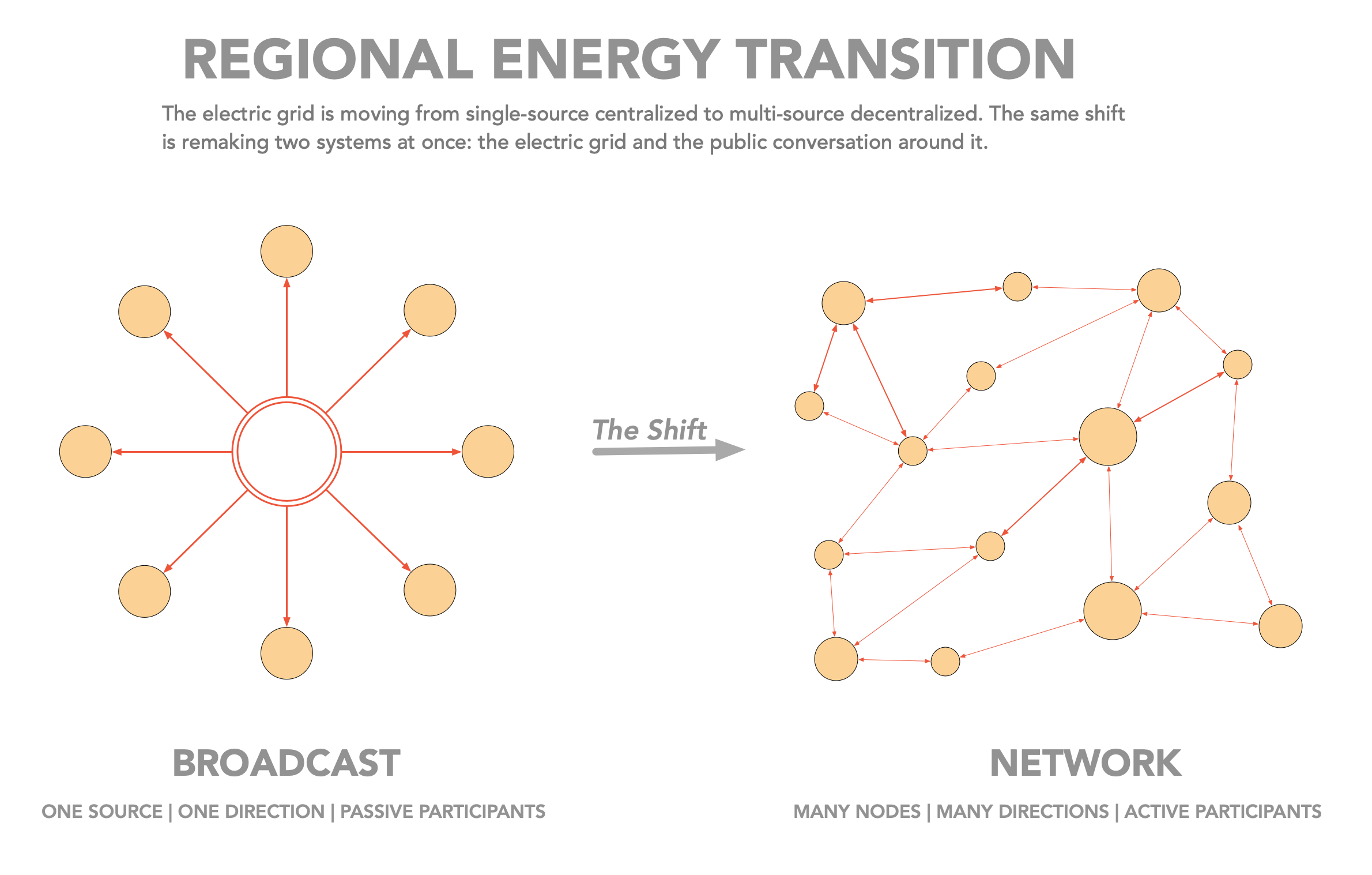
The legacy engagement process was built for a broadcast era. The process consists of events—public notice, comment periods, the hearing, the publication of record—strung together in a logical line. The design assumes information flows in one direction, from institutions to citizens, and that institutions control the channel. The governed are treated as an audience to be informed, not a network to be engaged.
You can see the assumption fossilized in the law. In Indiana, the statutory requirement for notifying the public about a planning meeting is still publication in a local newspaper. That made sense when the newspaper was how a community learned what its government was doing. Newspaper readership has since collapsed, but the statute has not moved. One workshop participant called the result a “perfect storm of public disconnection”: residents are not reached by the official channel, decisions get made without them, and then they feel blindsided. The process is doing exactly what it was designed to do. The world it was designed for is gone.
What the interactive medium actually did
The internet is our first interactive mass medium. This technology did not introduce a new flaw into this process. It invalidated the assumption that the process was built on.
For the first time, citizens can organize horizontally, in real time, faster than any utility or agency can respond. Information no longer waits for the hearing. It moves peer to peer, and so does mobilization. In Indiana, the same networks now move fluidly across technologies: anti-solar organizing becomes anti-wind organizing becomes anti-data-center organizing, often within months. The opposition does not distinguish between energy types. It opposes anything that breaks ground, and it is frequently better coordinated than the developers, utilities, and agencies on the other side of the table.
Resistance increasingly forms before a project is ever formally filed. In one Indiana county, a developer quietly acquired land under nondisclosure agreements; a resident learned about the project and, in a grocery store, confronted a county commissioner who knew nothing about it. By the time anything was public, the opposition had already organized around the vacuum. The official process had not failed to inform the community. It had not yet started, and the community had moved without it.
Why “more open” is not the fix
The temptation is to say the answer is a more open, more collaborative process. That instinct is right but dangerously incomplete, because the interactive medium is already open and collaborative—for opponents. Openness in the abstract just amplifies the loudest and best-organized voices, which is precisely the dynamic playing out now.
It is also worth being honest about cause and effect. The medium is the amplifier, not the injury. The injuries are structural, and they predate any Facebook group: secret land acquisition, nondisclosure agreements that bar local officials from telling their own constituents what is coming, one-way statutory notice, and state preemption that overrides local decisions. The interactive medium did not create these. It exposed them and made them impossible to contain. Treat the problem as misinformation, and you leave every one of those mechanisms intact.
Two decentralizations, one destination
Step back, and the engagement process is not the only thing moving from centralized to distributed. The energy system itself is.
For a century, the grid ran on a simple architecture: a small number of large central plants generating power and pushing it one way, out to passive consumers. That is the same broadcast logic that shaped the engagement process: one source, many recipients, one direction. It is dissolving for the same underlying reason. Renewables, distributed energy resources, microgrids, battery storage, and electric vehicles are pushing generation and balancing outward, toward the edges of the system. Data centers, the large concentrated loads driving today’s fights, do not reverse this trend. They intensify it. The increased demands from data centers have to be matched with additional generation. The demands cannot be absorbed by an abstract national grid.
The unit where this tension resolves is the region. Not the individual rooftop, and not the centralized state plan, but the region: the scale at which generation, load, water, workforce, and transmission can actually be balanced against one another. A distributed energy system is not a fragmented one. It means the region becomes the meaningful design unit — where supply and demand are dynamically balanced, infrastructure is planned, and trade-offs are made by the people who live with the consequences.
So the two decentralizations point to the same destination. The information system surrounding energy projects is decentralizing, and so is the energy system itself. Both are outgrowing the centralized institutions—state agencies, investor-owned utilities, broadcast-era notice statutes, and the traditional regulatory schemes. Regional energy transformation is not a slogan. It is the focal point where both energy and information transformations force the work to happen.
Redesigning for a networked world
If the old process assumed a broadcast world, the new one has to be built for a networked one. That means a process that is:
Continuous, not episodic. Engagement cannot begin at the hearing, after years of private land assembly. It has to run alongside development, from the moment a community is in play.
Multidirectional, not top-down. Technical information has to reach people in a language they can use, and community concerns have to travel back up a channel that actually carries them. Today, those two streams never meet.
Anchored by trusted local conveners. A state-run information campaign lacks credibility at the local level. The trusted messenger is the neighbor, the county commissioner, the person you already see at the grocery store. Building a network of credible local voices equipped with accurate information is a civic design problem, not a marketing budget.
Backed by real standing, early. Communities need genuine sign-off authority during the years developers spend on quiet land acquisition and preliminary design—not the right to comment after a project arrives as a finished fact.
This is a design challenge, and it can be approached like one: convene the people who actually have to say yes, give them something concrete to design, and let a workable process emerge from practice rather than from another round of model ordinances that counties will only answer with moratoriums.
The competitiveness stakes
This is not a question of civic nicety. It is a question of whether a state can build. Indiana’s strategy depends on landing the large concentrated loads—data centers, advanced manufacturing—that anchor major new generation and infrastructure investment. Those are exactly the projects the opposition has learned to stop.
States can offer every incentive on the books and still watch projects die in county moratoriums if the engagement process remains a broadcast relic. The places that figure out how to engage communities as partners, early and continuously, will be the places that actually capture the investment. The places that keep mistaking a structural failure for a messaging failure will keep losing projects, one angry hearing at a time. The blame game will accelerate.
The process is broken. Redesigning it is not a soft accompaniment to the energy transition. It is a precondition for it.
Sources:
“Q1 2026 produced the largest single-quarter concentration of blocked and delayed data center projects on record, with at least 75 projects worth approximately $130 billion disrupted by local opposition. The quarter reflected a structural shift rather than a cyclical spike: communities have internalized an opposition playbook, legislative sessions introduced formal regulatory uncertainty, and the number of active opposition groups more than doubled across 49 states.”
This article treats data centers as a bundle of overlapping systems problems: energy, water, air, land use, and equity. It also documents that more than $64 billion in projects were delayed or canceled between May 2024 and March 2025 due to organized opposition. The discussion of rate design, water-use monitoring, and transparency requirements provides a concrete menu of regulatory responses emerging as local governments catch up with the boom.
Jones, J. (2026) “Americans Oppose AI Data Centers in Their Area.” Gallup.
Seven in ten Americans oppose constructing AI data centers in their local area, with nearly half “strongly” opposed. The breakdown of reasons is analytically useful—roughly half of opponents cite excessive resource use (water and energy), while others emphasize pollution, quality-of-life impacts, and negative economic consequences such as higher utility bills and taxpayer subsidies.
Gorey, J. (2025) Data Drain: The Land and Water Impacts of the AI Boom. Lincoln Land Institute.
This article foregrounds land and water as the key limiting resources, emphasizing that even relatively small data centers can impose intense, localized burdens on infrastructure and ecosystems. The Newton County, Georgia example is useful for showing how what looks like an abstract “cloud” problem shows up as very concrete pressure on a specific aquifer, watershed, or agricultural landscape.
EESI’s article zooms in on water, explaining how large volumes of water used for cooling can overwhelm local wastewater facilities that were never designed for such loads. It also highlights the tension between data-center water draws and other community needs, especially in drought-prone regions.
The Duke report surveys sustainability challenges for hyperscale data centers and examines potential solutions, giving you a more technocratic and systems-oriented treatment. It situates AI-driven demand growth, grid impacts, water use, and cooling technologies, while also exploring mitigation strategies like renewable integration, waste heat reuse, and alternative cooling.